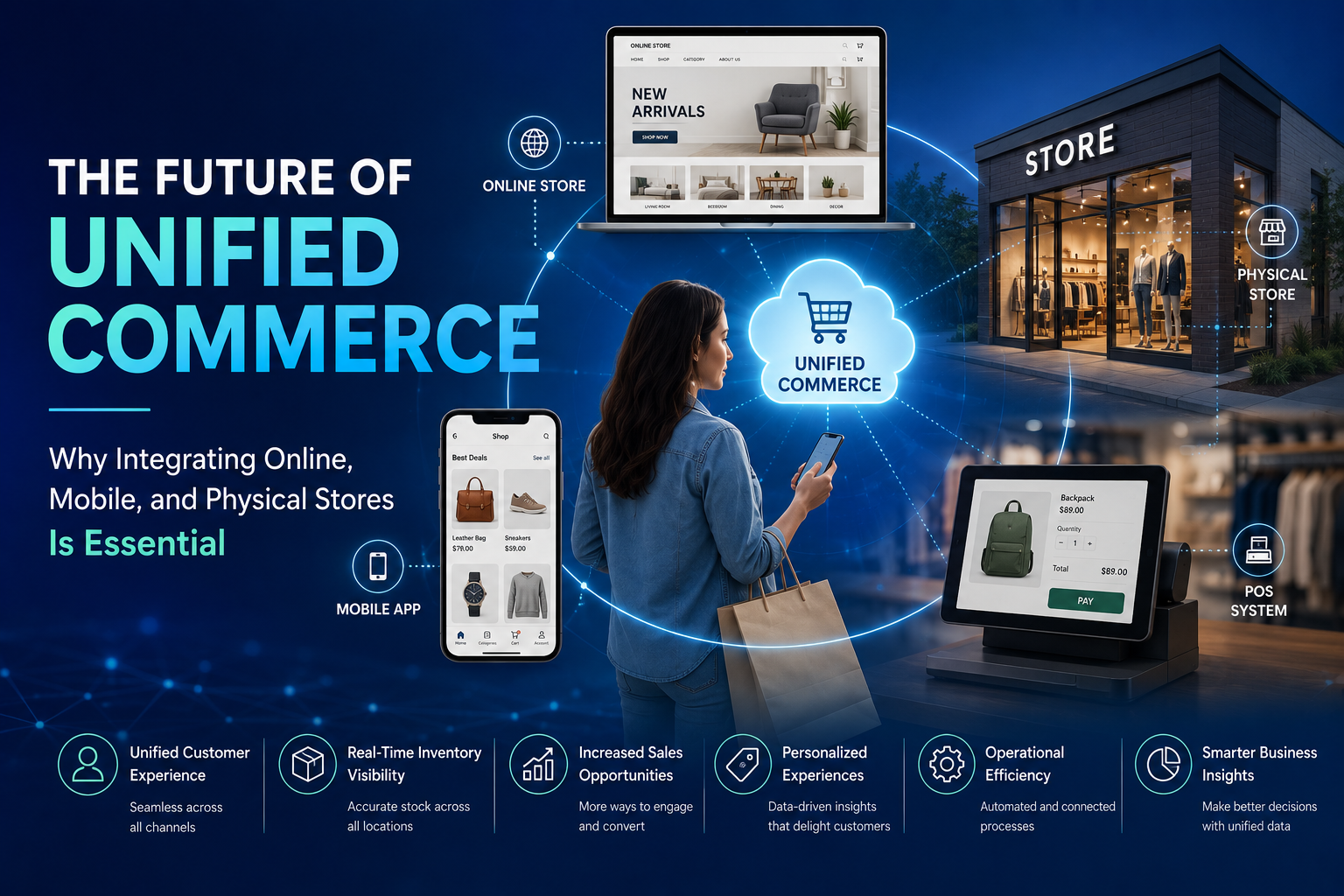
The Future of Unified Commerce: Why Integrating Online, Mobile, and Physical Stores Is Essential
Introduction
The way customers shop has changed dramatically. A customer may discover a product on social media, browse it through a mobile app, check its availability online, visit a physical store to see it in person, and finally complete the purchase through a website.
For customers, these interactions are part of one shopping journey. However, many businesses still manage their online stores, mobile applications, physical outlets, inventory, customer data, and payment systems separately.
This is where unified commerce is becoming increasingly important.
Unified commerce brings digital and physical shopping channels together through a connected technology ecosystem. Instead of treating websites, mobile apps, marketplaces, and physical stores as separate channels, businesses can create one consistent and integrated customer experience.
As competition in eCommerce and retail continues to increase in 2026, unified commerce is becoming an important strategy for businesses looking to improve customer experience, operational efficiency, and long-term growth.
What Is Unified Commerce?
Unified commerce is an approach that connects all customer-facing and operational commerce channels through a centralized technology infrastructure.
This can include:
- eCommerce websites
- Mobile applications
- Physical stores
- Marketplaces
- Social commerce
- Point-of-sale (POS) systems
- Inventory management
- Customer relationship management
- Payment systems
- Order management
- Loyalty programs
- Customer service
Instead of maintaining separate systems for each channel, unified commerce allows these systems to communicate and share information in real time.
For example, when a customer purchases a product through a mobile app, the inventory can automatically update across the website and physical stores. Similarly, a customer can check online whether a product is available at a nearby store before visiting.
The goal is simple: one connected commerce experience across every customer touchpoint.
Unified Commerce vs. Omnichannel Commerce
Unified commerce and omnichannel commerce are closely related, but there is an important difference.
Omnichannel commerce focuses on providing customers with a consistent experience across multiple channels. However, these channels may still operate using separate systems.
Unified commerce goes a step further by connecting the underlying technology and data that power those channels.
Omnichannel Approach
A business may have:
Website → Mobile App → Physical Store → Marketplace
Each channel provides a customer experience, but the systems behind them may operate independently.
Unified Commerce Approach
With unified commerce:
Website + Mobile App + Physical Store + Marketplace + Inventory + Payments + Customer Data
are connected through a centralized ecosystem.
This enables information to move between channels in real time.
Why Is Unified Commerce Becoming Essential?
Modern customers no longer think in terms of “online” and “offline” shopping.
They simply expect businesses to provide a convenient shopping experience wherever they interact with the brand.
A customer might:
- Discover a product through social media.
- Visit the website to learn more.
- Add the product to their cart using a mobile phone.
- Visit a physical store to view the product.
- Complete the purchase online.
- Receive the product through home delivery.
- Contact customer service through a messaging platform.
If these systems are disconnected, the customer may experience inconsistent information, unavailable stock, duplicated customer records, or complicated returns.
Unified commerce removes many of these barriers by connecting the entire customer journey.
1. Real-Time Inventory Across Every Channel
Inventory visibility is one of the biggest advantages of unified commerce.
Traditional retail systems may maintain separate inventory records for online stores and physical outlets. This can result in situations where a product appears available online even though it is actually out of stock.
A unified system can provide a centralized view of inventory.
For example:
Central Inventory
→ Website
→ Mobile App
→ Physical Stores
→ Marketplace
→ Warehouse
When a product is purchased through one channel, inventory can be updated across the other channels.
This improves stock accuracy and helps businesses make better fulfillment decisions.
2. Buy Online, Pick Up In Store
Consumers increasingly value flexibility when receiving their purchases.
Unified commerce makes services such as Buy Online, Pick Up In Store (BOPIS) much easier to implement.
A customer can:
- Browse products online.
- Check availability at a nearby store.
- Place an order.
- Receive a pickup notification.
- Collect the product from the store.
This creates convenience for customers while also giving physical stores an opportunity to generate additional sales.
For example, a customer visiting a store to collect an online order may purchase additional products during the visit.
3. Seamless Shopping Across Devices
Customers frequently switch between devices during the purchasing journey.
They may start browsing on a laptop, continue on a smartphone, and complete the purchase through an app.
A unified commerce strategy helps maintain continuity across these interactions.
For example, a customer can:
- Add products to a shopping cart on the website.
- Continue browsing through the mobile app.
- Receive personalized recommendations.
- Complete the payment using a digital wallet.
The customer does not need to restart the shopping journey each time they change devices.
4. One Customer Profile Across All Channels
Customer data is another major component of unified commerce.
Without integration, businesses may have separate customer records for:
- Website purchases
- Mobile app purchases
- Physical store purchases
- Loyalty programs
- Customer service interactions
This makes it difficult to understand the complete customer journey.
Unified commerce can create a centralized customer profile that brings these interactions together.
Businesses can gain insights into:
- Purchase history
- Product preferences
- Shopping frequency
- Preferred channels
- Customer service interactions
- Loyalty activity
This information can then be used to provide more relevant experiences.
5. Personalized Customer Experiences
When customer data and purchasing behavior are connected, businesses can deliver more personalized experiences.
For example, a retailer can recommend products based on a customer’s previous purchases, browsing behavior, and preferences.
Personalization can be implemented across:
- Website recommendations
- Mobile app notifications
- Email marketing
- Loyalty offers
- In-store promotions
- Personalized discounts
Instead of treating every customer the same, businesses can provide experiences that are more relevant to individual needs.
6. Flexible Order Fulfillment
Unified commerce also gives businesses more options for fulfilling customer orders.
Instead of depending entirely on a central warehouse, businesses can use inventory available across their network.
For example, an order can potentially be fulfilled from:
- Central warehouse
- Nearby retail store
- Regional distribution center
- Another fulfillment location
This can help businesses reduce delivery times and improve inventory utilization.
It also supports flexible models such as:
Buy Online → Pick Up In Store
Buy Online → Ship From Store
Order In Store → Deliver to Customer
Such flexibility can become an important competitive advantage.
7. Connected Payments
Payments are another important part of the unified commerce ecosystem.
Customers expect convenient payment options regardless of where they shop.
A connected payment infrastructure can support:
- Credit and debit cards
- Digital wallets
- Online payment gateways
- QR payments
- In-store payments
- Mobile payments
- Buy Now, Pay Later options
When payment information and transactions are properly integrated, businesses can provide a smoother checkout experience across different channels.
8. Easier Returns and Exchanges
Returns can become complicated when online and physical stores operate independently.
A customer may purchase an item online but have difficulty returning it to a physical store.
Unified commerce can simplify this process.
For example:
Online Purchase → Store Return → Refund
or
Store Purchase → Online Exchange Request → Home Delivery
When order history, payment information, and customer records are connected, businesses can offer more flexible return and exchange options.
This improves customer convenience and reduces friction after the sale.
9. Better Customer Service
Customer service teams need access to accurate information to resolve issues quickly.
With unified commerce, support teams can potentially view:
- Customer details
- Previous orders
- Current orders
- Payment status
- Delivery information
- Return history
- Loyalty activity
This means customers do not have to repeatedly explain their situation when moving between different support channels.
A connected customer service experience can improve satisfaction and build stronger customer relationships.
10. Better Business Intelligence
Unified commerce doesn’t only benefit customers. It also gives businesses a more complete view of their operations.
Instead of analyzing website sales, mobile sales, and store sales separately, businesses can analyze commerce data collectively.
This can help answer questions such as:
- Which products are performing best across all channels?
- Which locations have the highest demand?
- Which products are frequently purchased together?
- Which customers are most valuable?
- Which channel generates the highest conversion rate?
- Where are customers abandoning their purchases?
These insights can support better decisions related to marketing, inventory, pricing, and sales strategies.
The Role of AI in Unified Commerce
Artificial intelligence is expected to make unified commerce even more powerful.
Once customer, product, inventory, and transaction data are connected, AI can use this information to identify patterns and provide intelligent recommendations.
AI can support areas such as:
AI Product Recommendations
Recommend products based on customer behavior and purchase history.
Demand Forecasting
Predict future product demand and help businesses plan inventory.
Personalized Marketing
Create targeted campaigns based on individual customer preferences.
Intelligent Customer Support
Provide automated assistance through AI-powered chatbots and virtual shopping assistants.
Dynamic Pricing
Analyze market conditions, demand, and inventory to support smarter pricing strategies.
The combination of unified data + AI can help businesses move from simply reacting to customer behavior to proactively anticipating customer needs.
Key Benefits of Unified Commerce for Businesses
Implementing unified commerce can provide several advantages:
Improved Customer Experience
Customers receive a consistent experience regardless of where they interact with the business.
Better Inventory Management
Businesses gain greater visibility into inventory across locations and channels.
Increased Sales Opportunities
Customers can purchase products through their preferred channel without unnecessary restrictions.
Improved Operational Efficiency
Connected systems reduce manual data entry and repetitive processes.
Better Customer Insights
Businesses can understand customer behavior across the entire purchasing journey.
Greater Personalization
Connected customer data enables more relevant recommendations and promotions.
Faster Decision-Making
Centralized information gives management better visibility into business performance.
How Businesses Can Start Moving Toward Unified Commerce
Businesses don’t necessarily need to transform every system at once.
A phased approach can make implementation more manageable.
Step 1: Evaluate Existing Systems
Identify the current eCommerce platform, POS, ERP, inventory system, payment gateways, CRM, mobile applications, and other relevant systems.
Step 2: Identify Integration Gaps
Determine where customer, product, order, inventory, and payment information is currently disconnected.
Step 3: Establish a Central Data Strategy
Define how information should be shared between different systems and establish consistent data structures.
Step 4: Connect Critical Systems
Prioritize high-impact integrations such as:
eCommerce + Inventory + POS + ERP + Payment Gateway + Customer Data
Step 5: Improve Customer Journeys
Introduce features such as:
- Click and collect
- Real-time stock visibility
- Cross-channel returns
- Personalized recommendations
- Unified customer accounts
Step 6: Introduce AI and Automation
Once the underlying data is connected, businesses can gradually introduce AI-powered recommendations, predictive analytics, chatbots, and automation.
The Future of Unified Commerce
The future of retail will not be defined by choosing between online and physical stores.
Instead, successful businesses will connect every channel to create one continuous customer journey.
A customer should be able to discover a product through social media, research it online, check availability through a mobile app, visit a store, purchase it through any available channel, and receive support afterward—all while experiencing one consistent relationship with the brand.
This is the direction in which unified commerce is moving.
As technologies such as artificial intelligence, mobile commerce, cloud platforms, automation, and real-time analytics continue to evolve, businesses will have more opportunities to create connected and intelligent retail ecosystems.
Conclusion
Unified commerce is more than simply connecting an online store with a physical shop. It is about creating a single, connected commerce ecosystem where customers, products, orders, inventory, payments, and business data can move seamlessly across channels.
For businesses operating websites, mobile apps, marketplaces, and physical stores, this approach can improve customer experience, increase operational efficiency, and create new opportunities for growth.
The businesses that succeed in the future will not necessarily be those with the most sales channels. They will be the ones that connect those channels most effectively.
As customers continue to expect faster, more personalized, and more convenient shopping experiences, unified commerce is becoming an essential foundation for modern retail.
The future of commerce isn’t online or offline—it is unified.