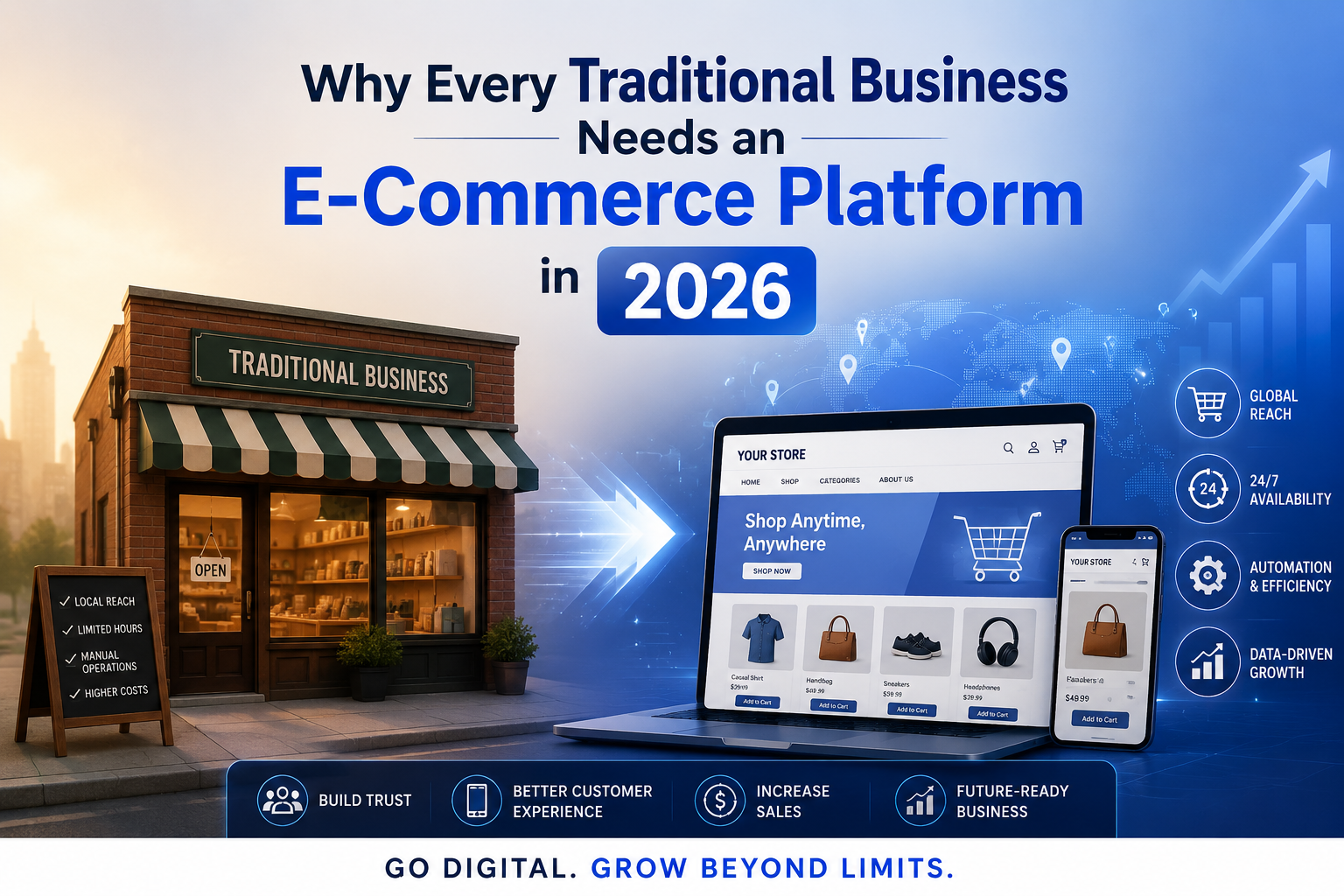
Why Every Traditional Business Needs an E-Commerce Platform in 2026
For decades, traditional businesses have relied on physical stores, sales representatives, phone orders, and word-of-mouth referrals to drive revenue. These methods built strong businesses and loyal customer bases. But the market has shifted — and businesses that have not yet made the move to digital sales are leaving significant opportunity on the table.
Converting traditional sales to digital is not about replacing what works. It is about extending your reach, improving your efficiency, and future-proofing your business in a world where customers increasingly expect to shop on their own terms.
Your Customers Are Already Online
This is the most straightforward reason of all. Regardless of your industry, your customers are spending time online — researching products, comparing prices, reading reviews, and making purchasing decisions. If your business does not have a digital presence where transactions can happen, you are simply not part of that conversation.
An e-commerce platform puts your business exactly where your customers already are, available at any time, on any device, from anywhere in the world.
Sales Are No Longer Limited by Location or Hours
A traditional store or sales team operates within fixed boundaries — opening hours, geographic reach, and available staff. An e-commerce platform removes all of those limitations. Your store is open twenty-four hours a day, seven days a week, reachable by anyone with an internet connection.
For businesses in Sri Lanka and across South Asia, this is a particularly significant opportunity. Digital platforms allow local businesses to serve customers nationally and even internationally without the overhead of physical expansion.
Operational Efficiency Improves Significantly
Traditional sales processes often involve manual order taking, paper-based records, phone follow-ups, and time-consuming invoicing. An e-commerce platform automates much of this — orders are captured digitally, inventory is updated in real time, payment is collected at checkout, and customers receive automated confirmations and updates.
This reduces human error, frees up staff time for higher-value tasks, and creates a cleaner, more reliable sales operation. For businesses managing multiple product lines or high order volumes, the efficiency gains alone justify the investment.
Customer Data Becomes a Business Asset
One of the most underappreciated advantages of digital sales is the data it generates. Every visit, every search, every purchase, and every abandoned cart tells you something about your customers — what they want, when they buy, what price points they respond to, and where they drop off.
Traditional sales rarely capture this level of insight. An e-commerce platform turns customer behaviour into actionable intelligence that can improve your product offering, marketing strategy, and overall business decisions.
Marketing Becomes Measurable and Targeted
Traditional marketing — brochures, billboards, trade fairs — is difficult to measure and expensive to scale. Digital sales channels connect directly to digital marketing tools, allowing you to run targeted campaigns, track exactly how many people saw your ad, clicked through to your store, and completed a purchase.
This level of visibility means every marketing dollar works harder. You know what is performing, what is not, and where to invest more.
It Strengthens Customer Relationships
An e-commerce platform is not just a sales tool — it is a relationship-building platform. Through email marketing, loyalty programmes, personalised recommendations, and post-purchase follow-ups, businesses can stay connected with customers long after the initial transaction.
Traditional sales often lose touch with customers between purchases. Digital platforms keep the conversation going, increasing repeat purchases and building long-term brand loyalty.
Competitive Pressure Is Real
In almost every industry, competitors are already online. Businesses that delay their digital transition are not just missing growth opportunities — they are actively ceding ground to competitors who are capturing the customers they should be serving.
The longer the transition is delayed, the wider that gap becomes. In many markets, the window to establish early digital authority is closing quickly.
The Investment Is More Accessible Than Ever
A common reason businesses delay digital transition is the assumption that building an e-commerce platform is expensive and complex. In 2026, that barrier has largely been removed. Modern platforms offer scalable, affordable solutions that can be set up and launched quickly, with ongoing costs that are a fraction of maintaining a physical sales infrastructure.
The return on investment from a well-implemented e-commerce platform — through increased reach, reduced operational costs, and higher sales volumes — typically far outweighs the initial setup investment.
A Phased Approach Works Well
Transitioning from traditional to digital sales does not have to happen all at once. Many businesses begin by listing their core product range online, integrating their existing inventory, and training their team on the new workflow. As confidence and sales grow, additional features — loyalty programmes, advanced search, personalised recommendations, third-party integrations — can be added progressively.
This phased approach reduces risk, allows the team to adapt, and ensures the platform evolves in line with actual business needs rather than assumptions.
Digital Sales and Traditional Sales Can Coexist
For businesses with established physical stores or field sales teams, going digital does not mean dismantling what already works. The most effective transition strategy integrates both — using the e-commerce platform to extend reach and capture online demand, while maintaining the personal relationships and service quality that traditional sales excel at.
The result is a business that serves customers across every channel, captures more of the available market, and operates with greater resilience against disruption.
The shift from traditional to digital sales is not a trend — it is a permanent change in how commerce works. Businesses that embrace this shift with a clear strategy and the right platform will find themselves better positioned to grow, adapt, and compete in the years ahead.
The right time to make the move was yesterday. The next best time is now.